
Measures
AI cognitive debt
The 2-minute score maps how much agency has moved out of your own attention, memory, reasoning, and decisions.
Evidence-informed. Dose-focused.
MIT Media Lab, Microsoft Research, Wharton, Princeton and others point to the same risk: when AI does the thinking too early, the circuit does less work.
Direct answer
The Anti-AI Brain is a 30-day protocol for using AI without outsourcing your thinking. It is written for knowledge workers, founders, writers, students, and operators who use ChatGPT, Claude, Gemini, or similar tools daily and want to keep their attention, memory, reasoning, and decision-making under human control.
The simplest test is behavioral: do you open ChatGPT before you have one rough thought of your own? The protocol gives that first rep back to you.
The book does not argue for quitting AI. It treats AI as pharmakon: medicine or poison depending on dose. The protocol teaches readers to think first, prompt second, and use the machine as a sparring partner instead of a ghostwriter.
Measures
The 2-minute score maps how much agency has moved out of your own attention, memory, reasoning, and decisions.
For
Operators who want the leverage of AI without training themselves into dependency on the next autocomplete.
Changes
By Day 30 the goal is simple: think before prompting, then use AI to challenge, test, and sharpen the thought.
Evidence
The public evidence ledger tracks the MIT, Microsoft, Princeton, Wharton, and neuroplasticity claims behind the protocol.

Evidence, calmly
AI is powerful. The risk starts when it does the thinking before you do.
What research suggests
Microsoft Research reported that higher confidence in AI was associated with lower critical-thinking effort among knowledge workers.
Where risk appears
The studies cited here point to a practical distinction: ask AI for hints and critique, not for the first answer.
What this does not prove
It supports a dose problem. Think first, prompt second, and use the model to challenge the work instead of replacing the work.
What You Get
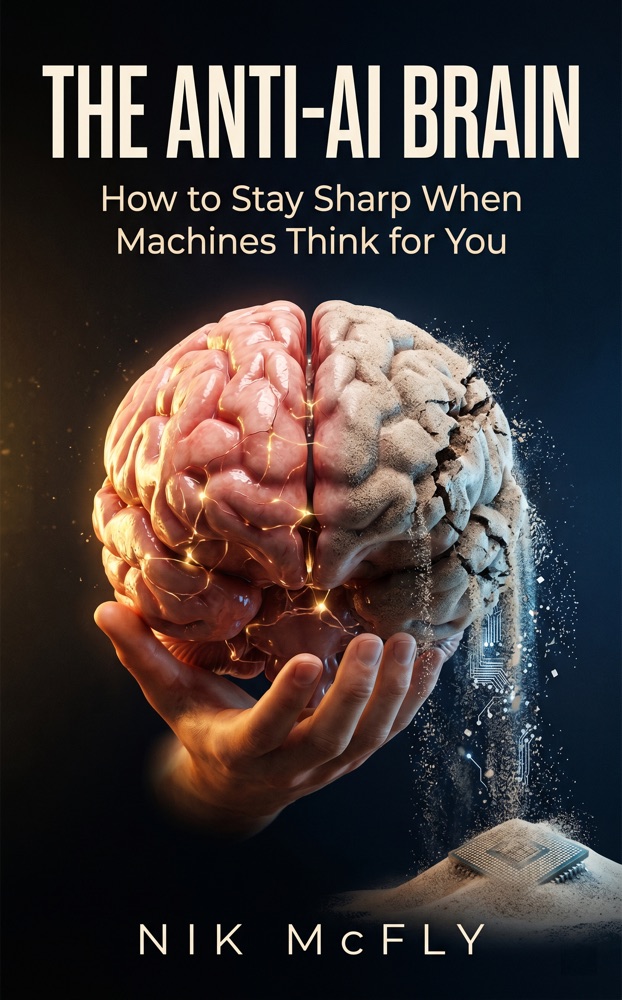
Buy the Kindle edition, claim the bonus stack by email, and start with the first protocol step today.
Inside the book
Reader bonuses
Before / After
Same person. Different dose.
Default use of AI
The Anti-AI protocol
The Arc
Three moments. One protocol. Same person.
DAY 0 · NOW
You reach for the machine before you think. The fog has become normal.
DAY 7 · FRICTION
Reading, writing, deciding without a screen feels wrong. The discomfort is the repair.
DAY 30 · SOVEREIGNTY
You use AI harder than most — and think before you prompt. The tool does not use you.
The Four Circuits
The protocol targets the four cognitive functions AI degrades fastest. Each circuit gets a research-backed recovery path.
Attention
The protocol rebuilds the attention substrate that AI-assisted writing can leave underloaded: reading without a device, writing before prompting, and holding one task long enough for depth to return.
Memory
You stop storing pointers and start storing substance. The month reinstalls handwritten notes, recall, teaching, and spaced retrieval so the idea is in you, not only in a tab.
Reasoning
Instead of asking the model for the first answer, you write the ugly first pass, then use AI for Socratic challenge, steel-manning, and falsification. The work starts in your head again.
Decisions
AI can critique the call after you make it. It does not get the first vote. The protocol puts judgment, tradeoffs, and responsibility back on your side of the desk.
The Anti-AI Seven
Each practice targets a layer of the cognitive stack. The book gives the day-by-day schedule; the cards below show the operating system.
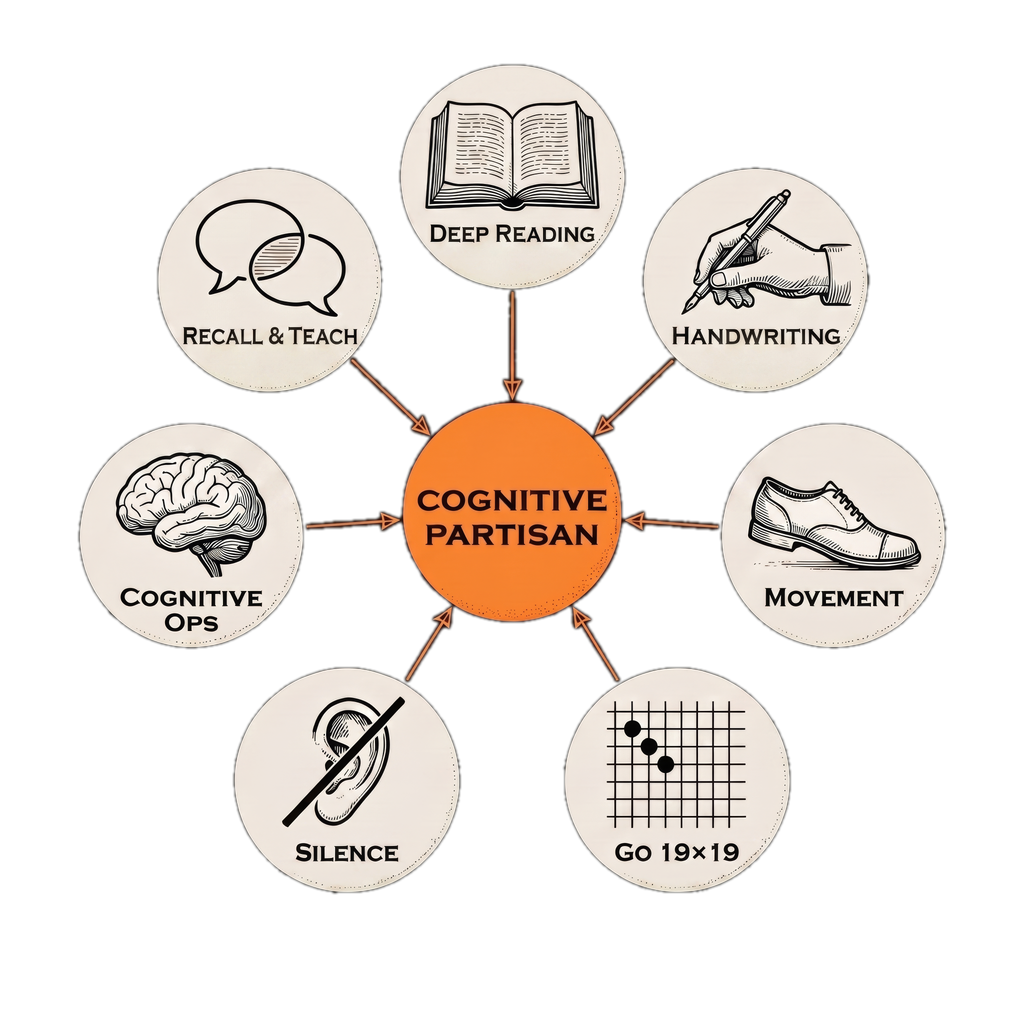
One paper book. Sixty minutes. No notification device within reach.
Twenty minutes a day, longhand. Van der Meer's EEG work shows why typing does not substitute.
Forty-five minutes of physical load. The brain that grows is the brain with oxygen pressure.
Go, chess, or equivalent. Four-thousand-year-old games that no AI coach can shortcut for you.
Thirty minutes a day with no phone, no input, no task. The default mode network does the work you cannot schedule.
Claude as sparring partner, not ghostwriter. Socratic mode, steelman mode, falsification mode.
Explain a concept without looking it up. The circuit that stores is the circuit that retrieves.
Inside the book →
FAQ
All 18 questions on /faq — science, protocol, logistics, refunds →
The Dose Decides
Thirty days from now, one of two brains will own the body you live in.
The brain that drafted, weighed, struggled, recalled, and chose. Or the brain that approved, tweaked, and sent. You choose which.
Available now · Kindle $9.99